Review: “Metal Soul Mercy” Mesmerizes with Showgirls, Glitches, and Glitz
Metal Soul Mercy
Written by Maci Zakarin
Directed by Hana Lauer
Ensemble Choreography by K-A Nassoura
Duet Choreography by Maci Zakarin
Fools Rush In Choreography by Mariama Condé
Presented at The Slipper Room
1167 Orchard St., Manhattan, NYC
June 2, 2026

The evening begins with Olive (Mariama Condé) peeking through the curtain, unable to resist the gathering gaze. It is a small gesture, playful and inviting, but it encompasses the entire production in miniature. The Ladybugs want to be seen; they need to be seen. And soon enough, we meet the girls – performers who have only ever known life under the spotlight, “born in fishnets and a bustier.” Maci Zakarin’s Carolina jokes that she was born addicted to applause, and the line lands as comedy, but it also announces the play's central concern. To be watched here is not merely to be desired: it is to be sustained.
Written by Zakarin and directed by Hana Lauer, Metal Soul Mercy begins as a glittering cabaret fable full of dance, flirtation, prayer, gossip, and theatrical longing. The Ladybugs believe themselves to be creatures of earth and light, born from nature and destined for performance. Then comes the revelation: they are robots, manufactured entertainers whose continued existence depends on their ability to draw a crowd. The brilliance of the production is that the revelation changes remarkably little. By the time we learn the truth, the audience has already laughed with them, rooted for them, and fallen under their spell. The category arrives too late to undo recognition.
The Slipper Room provides the production with its ideal home. Audience members crowd cocktail tables, piano benches, and windowsills. Applause, cheers, boos, actual hisses, and laughter become part of the evening's texture. Narratively, this setup allows the production to implicate the audience in its own questions. Both the show’s villain, Corthindius, and the clean-up man known just as the CEO emerge from among the spectators, making their gaze part of the same equation as ours as viewers. We are not simply watching a play about performance – we are participating in the system that gives the Ladybugs life.
The production’s choreography is nothing short of existential. Dance becomes the Ladybugs' primary language, carrying longing, sensuality, competition, fear, and the need for connection. Their movement is less entertainment than proof of presence and existence. Again and again, all elements of Mercy’s production circle around the possibility that performance itself may be a form of being – temporary and fragile perhaps, but no less real for either fact.
Zakarin’s Carolina emerges as the production's catalytic force. Physical, funny, and completely at ease engaging the entire room, she embodies the play's central paradox: her sensuality survives the robot reveal because her performance itself is just that compelling. The audience continues to respond exactly as before, laughing, watching, and leaning in. That continuity becomes the point. Zakarin's comic timing repeatedly lands, from Carolina's exuberant defense of pleasure to her memorable speculation about a future spent as an actual ladybug "on a leaf? In an oak tree? Eating aphids?" Even the evening's biggest laugh, an unforgettable line about her clitoris delivered at precisely the right moment, grows naturally from a character determined to remain fully herself.
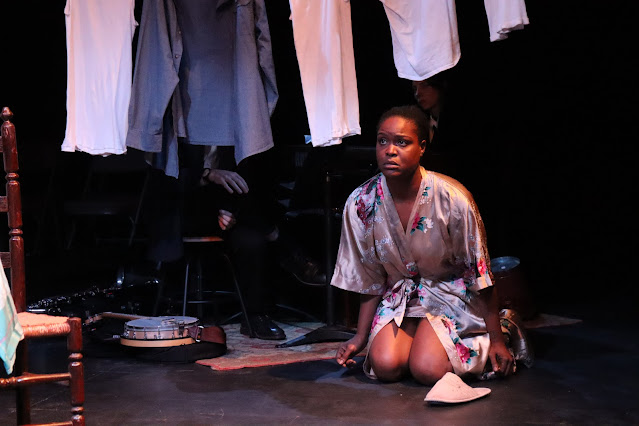
Condé gives Olive the production's most exposed emotional register. Moving effortlessly between song and sensuality, romantic yearning and heartbreak, Condé makes Olive's desire for connection feel both hopeful and dangerous. Her scenes with Corthindius reveal the cruelty at the heart of the play's world, where affection (and existence) can suddenly become conditional. Particularly striking is a beautifully simple scene shared with Carolina, staged with little more than pillows held to their heads as they imagine themselves whispering secrets in bed together. The moment demonstrates how little theatrical machinery is needed when performers are this specific: we are transported entirely by their very human care for one another.
Lauer's Alani carries the burden of knowledge with quiet authority. As the only Ladybug aware of the truth, she occupies the uneasy space between protector and gatekeeper, increasingly worn down by the weight of what she knows. Opposite her, Doğa Ozbilun brings warmth, intimacy, and spiritual generosity to Mila. Their scenes together feel lived in and deeply affectionate, grounding the production's larger questions in genuine emotional connection. Ozbilun’s Mila also frames the evening through prayer, offering moments of collective reverence to beautifully bookend the action.
As Corthindius and the Showman, He-Myong Woo supplies the evening with its necessary menace. Sporting a bowler hat and the confidence of a classic vaudevillian heel, Woo understands that the character's power lies in his charm. He first appears as admirer, then gradually reveals himself as something far more controlling. His gaze is seductive, possessive, and ultimately transactional.
What makes Metal Soul Mercy more than a clever robot-showgirl fable is that it never asks the Ladybugs to prove they are alive. They dance, flirt, panic, pray, love, and fear extinction – and the audience does the rest. The Showman sees products, outdated models, and expendable performers. The production, aling with the audience, sees relationships. By the time the threat arrives, the Ladybugs have been understood to be performers, their ontological status on nary a mind at the Slipper Room tonight.
The performance’s final sequence lands with remarkable force. As the spotlight narrows and the Ladybugs wonder what will become of them when the performance ends, the room's earlier earthy delights give way to stunned attention to loss. When they are physically removed from the stage, the moment registers not as a mechanical shutdown but as a genuine loss.
That is the defiant impermanence at the heart of Metal Soul Mercy. The play understands that theatre itself is fleeting, dependent on attention, and destined to disappear. Yet for one night at the Slipper Room, the Ladybugs danced, joked, loved, feared extinction, and demanded to be seen.
-Noah Simon Jamopol


Comments
Post a Comment