Review: “Clay Mommy”: Truth and the Burden of Need
Clay Mommy
Written by Aviva Pearl Ocean Creation
Directed by Lili Rosen
Presented by FRIGID New York at UNDER St. Marks
94 St. Marks Pl, Manhattan, NYC
June 4-7, 2026
.PNG)
Written by Aviva Pearl Ocean Creation, directed by Lili Rosen, and presented by FRIGID New York at UNDER St. Marks, Clay Mommy is a funny, painful, and deeply Jewish meditation on care, dependency, and the risks of trying to shape another person into an answer for our loneliness.
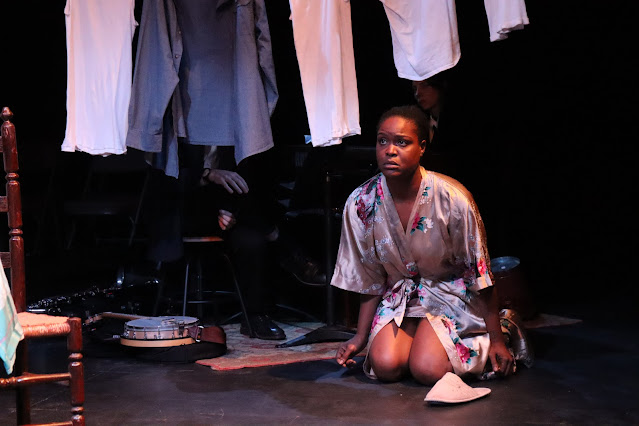
The production uses the stripped-down confines of UNDER St. Marks to fine effect. A backpack, a sparkling dress, and a sculpture in progress do much of the visual storytelling. The minimalism works because the play's real landscape is emotional and unflinchingly Jewish. Violet (Aviva Pearl Ocean Creation) has returned home after years away, hoping to reconnect with her grandmother Hana (Lili Rosen), only to discover she has died. Waiting instead is her estranged mother, Michal (Corbin Allardice), and all the hurt that accompanies her. Violet's response is both mystical and profoundly human: she fashions a golem in Hana's image and brings her grandmother back from the dead.
The resulting Hana becomes the production's most haunting image. Rosen's performance never allows the audience to settle into comfort. This Hana is recognizable but uncanny, loving but frightening, familiar yet unmistakably altered. Standing beneath the stark letters of אמת, she embodies the tension at the center of the play. The golem is not a solution. She is a longing given physical form.
That tension extends through every relationship on stage. Clay Mommy is full of mothers and daughters, but it is equally concerned with people trying unsuccessfully to become what someone else needs. Michal wants reconciliation while carrying wounds of her own. Violet longs to mother Lior (Mitchie LaDue) while still searching for a mother herself. Even Hana's return reveals the limits of fantasy. Resurrection cannot make another person whole, and it cannot make a relationship simple.
Creation gives Violet a searching quality that anchors the evening. Loving, vulnerable, and often more powerful than she realizes, Violet spends much of the play trying to build a future from inherited pain. Creation wisely resists self-pity, allowing Violet's yearning to remain active, searching, and complicated.
The evening's strongest performance comes from Mitchie LaDue as Lior. Youthful, funny, tender, and increasingly furious, LaDue captures the volatility of someone struggling toward self-definition while remaining open to connection. The chemistry between Violet and Lior becomes one of the production's most compelling elements: their relationship slips productively between friendship, mentorship, kinship, and something more difficult to name. When Lior's anger finally erupts and plates begin to shatter, the scene lands with shocking force to an audibly disturbed audience. The outburst feels earned because LaDue has spent the evening revealing the vulnerability beneath it.
As Michal, Corbin Allardice embodies the contradictions of motherhood with remarkable complexity. Funny, tempestuous, loving, overbearing, and wounded, Michal never becomes merely an obstacle or antagonist or pastiche of Jewish maternity. Instead, she emerges as another person burdened by unmet needs. One leaves the theatre with the distinct impression that she, too, is still searching for a mother.
Rosen's Hana serves as the production's moral memory. Whether delivering sharp humor or channeling intergenerational pain, Rosen grounds the supernatural without diminishing its strangeness. The performance understands that the golem's power lies in contradiction. She offers comfort while simultaneously exposing the impossibility of perfect care.
The play's Jewishness emerges organically through folklore, prayer, family history, and language. One of the evening's biggest laughs arrives with a cry of "loshen hara," greeted by immediate recognition from an audience clearly fluent in the world the play inhabits. The moment exemplifies the production's confidence. Clay Mommy trusts its audience enough not to explain itself.
What ultimately distinguishes the production is its refusal to offer easy cures (save, perhaps, a shared plate of shakshuka). The golem does not heal the family. Love does not erase disappointment. Chosen family and biological family alike remain sources of both sustenance and danger. Yet the play resists cynicism. Its characters continue reaching for one another despite repeated failures. They continue risking connection despite the certainty of being hurt.
By the end of the evening, the image that remains is Hana standing, marked and animated by אמת, a grandmother fashioned from clay and longing. The word means truth, and Clay Mommy proves willing to confront one of the hardest truths family can offer: the people we love cannot become perfect answers to our grief, loneliness, or need. They never could. Yet we keep reaching for them anyway. The burden of that need, and the courage required to carry it, gives Clay Mommy its strange and moving power.
-Noah Simon Jampol


Comments
Post a Comment