In the Devil's Hands
11-51 44th Rd, Long Island City, Queens, NYC
May 20-June 14, 2026
 |
| Rory Greenwood and Umer Khan. Photo by Diego Quintanar. |
There is something undeniably attractive about the idea of removing oneself from society to live in independent solitude, and, unlike the protagonist of new play
In the Devil's Hands, most of us don't even have as compelling a motivation for such fantasizing as being suspected of murder.
In the Devil's Hands, by Helen Banner, Creative Director of Zoopraxic, a new arts space in Long Island City, takes inspiration from the story of Alphonse Le Gastelois (1914-2012), a resident of Jersey, the largest of the Channel Islands and a British Crown Dependency. In 1961, Le Gastelois exiled himself to an island in the Écréhous reef, six miles from Jersey, after having been targeted as a suspect in a series of sexual assaults on children that would not be solved until a decade later. Banner, who grew up on the Channel Islands, employs this skeleton of the situation as a jumping-off point for
In the Devil's Hands, which places its fictional crimes and characters in the mid-1940s, following the end of the Nazi occupation of Jersey during the Second World War. Captivating and immersive, the production uses its small cast and intimate space to explore big questions about one's relationship and obligations both to others and to oneself, as well as about how we (should) expend our limited lifespans.
 |
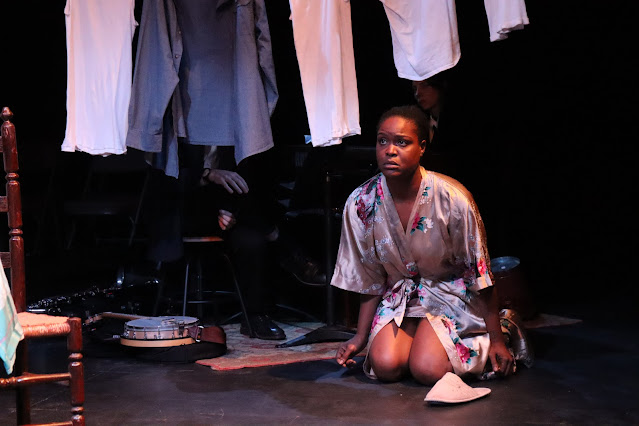
| Rory Greenwood, Phoebe Lloyd, and Umer Khan. Photo by Diego Quintanar. |
The first voice that the audience hears as the play opens belongs to playwright and director Banner, in a voiceover of a radio interview in which she plays herself and Joshua Dumas takes the role of interviewer. This fascinating meta element returns at several points throughout the play, and in this first instance comments on the loss to time of the Channel Islands' unique "voices," literally its accents but also suggestive of the past that the play is more interested in maintaining a connection with than is its protagonist, agricultural laborer Jason (Rory Greenwood). As the voiceover plays, Jason and his friend Dill (Umer Khan), a radio engineer, arrive on an islet known as The Devil's Hands, represented by an ingeniously constructed raised, rocky-looking island the edges of which sit no more than a couple of feet from any given audience member. Having been interrogated by the police in connection with a pair of murders of young women, Jason has asked Dill to row him out to The Devil's Hands with the intention of staying there until there is another attack in order to prove that he is not the guilty party. Despite not having provisioned himself very well for this plan, Jason does manage to stick it out, but by the time Dill comes back, Jason has had perhaps too much time to brood over events and has become resentful that his fellow residents on the main island could have suspected him, prompting him to refuse to return with Dill. As Jason's time in self-exile draws on, it is hard not to see a selfish aspect to his remaining, a parallel with an anecdote in one of Banner's voiceovers about a relative who used an illness to exert control over those around her for decades by taking to her bed. Jason gains power in a similar way over Dill, who feels responsible for keeping tabs on Jason via the two-way radio that Dill left with him and for rowing periodically out to The Devil's Hands, while his becoming a sort of celebrity on the main island over time constitutes its own kind of power. At the same time, Jason's musings on whether his isolation mitigates against immorality are not without justification, and his worry that returning from exile would mean being permanently stuck in and talking about the past has merit (though what are we as human selves if not an accumulation of past moments?). Jason's not being especially good with women (in contrast to Dill, whose friends are nearly all women) probably contributed to the original suspicion against him, but he clearly retains an interest in Dill's vivacious sister, Lydia (
Phoebe Lloyd), and she is eventually drawn into the issue of Jason's return. What ultimately transpires is determined by the actors themselves each evening, allowing the narrative to rewrite itself–to reinvent its own past–with each repetition.
 |
| Phoebe Lloyd. Photo by Diego Quintanar. |
Throughout, the production does a fantastic job of aligning the audience with Jason's experience. The susurration of the sea, part of the live sound performance by Dumas, forms an unceasing backdrop in Zoopraxic's "micro theatre" space; there are no blackouts to mark scene changes or the passage of time (though the lighting design does a splendid job of evoking different times of day); and the audience only sees other characters when Jason speaks to them on the radio (Dill's home is established with minimal bits of set along the wall behind one row of audience seats) or they visit him. Jason never steps off the set's "island" over the course of the play, while its height creates a sense of separation (from audience and world), and coming to the island is smartly played as an effortful journey each time, with Khan, in a representation of rowing to the island, seeming to pull himself along a thick mooring line. Khan and Lloyd are both excellent as Dill's sympathy with and commitment to his friend are increasingly tested and Lydia makes a long-distance connection with Jason, but to undetermined effect. Greenwood as Jason himself gives a marvelous performance, keeping the audience spellbound as his character cycles through illness, despair, acceptance, stubbornness, resilience, and uncertainty, marked sometimes by changes in how Jason speaks, holds himself, or even (un)focuses his gaze. Lydia argues at one point that "our lives should be about others," about helping them and being loved by them (very much not what happens with the serial attacks). If Jason is rejecting this existential purpose by staying in exile, are those he left behind doing the same by not threatening to stop giving Jason that help and love on his own, assertively idiosyncratic terms?
In the Devil's Hands will leave you with plenty to contemplate after you've left the theater…and as you decide whether to return to see how things play out on another night.
-John R. Ziegler and Leah Richards



Comments
Post a Comment