Waiting for Gadot
312 West 36 Street, Floor 3, Manhattan, NYC
February 6-21, 2026
 |
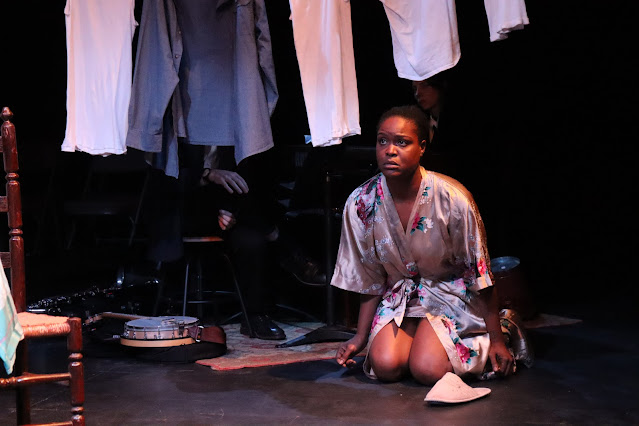
| L to R: Ellie Lauther, Gabi Schwartz, Nicole Lado, Kaia Parnell, Spencer Hazen, Isabel Criado. Photo by Callee Egan. |
Most of us have at some point in our lives done something in imitation of a celebrity whom we admire. Maybe that was taking up an instrument. Maybe it was purchasing something (makeup? clothing? cryptocurrency?) because of an endorsement. Maybe, as in
Waiting for Gadot, it was eating oily muffins out of a trash bag. Who can say? The characters in
Waiting for Gadot, which made its debut at the Chain Theatre's Winter One-Act Festival this February, are focused on the anticipated arrival not of the ambiguous figure of the Samuel Beckett play on which it riffs but the quite specific, real-life actor Gal Gadot. With
Waiting for Gadot, playwright Annabel McConnachie–whose
Archive of My Own and
Doing a Bradbury also examine aspects of our relationship to fame and the famous (media as well as persons)–takes absurdist aim at the social-media-supercharged tendency to offload agency onto parasocial relationships.
 |
| Kaia Parnell, Nicole Lado, Annabel McConnachie. Photo by Callee Egan. |
Waiting for Gadot unfolds over one act to
Godot's two, but it triples the groups of waiters. Mara (
Isabel Criado) and Len (Spencer Hazen) are bakers in a local cafe. There's also a film crew consisting of an unnamed director (
Nicole Lado), producer (Kaia Parnell), and assistant (Annabel McConnachie). And superfan Jay (Ellie Lauthner) waits with her friend Morgan (
Gabi Schwartz). After audio from the Gadot-led "Imagine" serves as a cheeky intro with the lights still down, these groups are introduced, first individually and then together, in pools of light within a larger darkness, an effect that not only separates them in terms of location but also suggests a more existential separation. Mara, the director, and Jay all assert in this opening scene that today is definitely the day that Gadot will finally come. The others are less convinced, but their pushback does not extend to actually leaving. The director, as proof, points to her phone and a post that says Gadot was spotted jogging nearby (notably, as the producer points out, the source is unverified), while Jay berates herself for not factoring water breaks into her attempt to calculate Gadot's exact arrival time. That her attempt is based on "research" that includes knowing how much water Gal Gadot drinks each day highlights the strange, intrusive levels to which parasocial relationships can rise, as well as the role of the internet in what amounts to a kind of intense surveillance in which the celebrities themselves often participate. Debates among those waiting give way, as the play goes on, to an uproarious chain of misunderstandings and, relatedly, viral escalation. When one character finally hits a breaking point with all of this, will the others listen?
 |
| Ellie Lauther, Gabi Schwartz. Photo by Callee Egan. |
When Jay begins to make Morgan exercise as a Gal stand-in in order to revise her estimates, the fact that this involves Morgan running in a circle seems unavoidably symbolic. And later, when the pair show up at the bakery in pursuit of what they believe to be muffins intended for Gadot, their quest can be seen in the light of the basically magical quality that we attach to things that celebrities have signed, worn, even touched, a way of thinking that stretches back at least to the pre-modern relics industry. The behavior that
Gadot satirizes, then, is new in its scale, what the play calls an "epidemic," and intensity rather than in its character.
Waiting for Gadot also links this behavior to the failure of religion, government, and even parents to satisfy people's need for meaning and guidance, leaving the masses with some questionable choices of idolization (McConnachie makes some dryly excellent jokes about Gadot's accomplishments). But if people decide to cede their agency in making change in their lives, is(n't) one celebrity/leader/deity as good as another? (Arguably the same impulse to look for change or meaning or some sort of salvation to flow from a more powerful person abets the election of authoritarian leaders.) In the play's engagingly exaggerated (one hopes) portrait of paralyzing parasociality, both Criado, Lado, and Lauthner's periodically pushy true believers and Hazen, Parnell, and Schwarz's skeptical but supportive doubters are equally hilarious, as is McConnachie's assistant, silently and assiduously scribbling notes through much of the production before injecting it with a jolt of additional energy when she eventually breaks that silence. In the end, Gadot may or may not arrive, but audiences will have a great time waiting.
-John R. Ziegler and Leah Richards



Comments
Post a Comment