The First Line of Dante's Inferno
Directed by Christian Parker
66 East 4th Street, Manhattan, NYC
February 5-22, 2026
 |
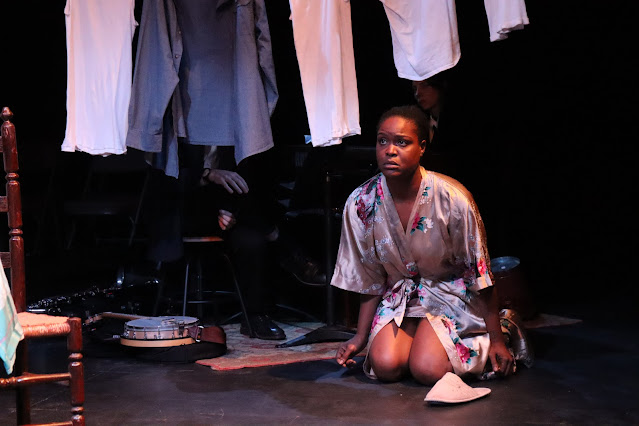
| The First Line of Dante’s Inferno, featuring Kelli Overbey and Evan Sibley. Photo by Marina Levitskaya |
Inferno, the first of the three parts that make up Dante Alighieri's narrative poem
The Divine Comedy (c. 1321), famously begins with its narrator's declaration that he has, in midlife, departed from "the straight road" to awaken lost in "a dark wood," in the words of the translation employed in the exceptional new experimental play
The First Line of Dante's Inferno.
The First Line of Dante's Inferno, written by Kirk Lynn, a playwright, novelist, screenwriter, educator, and one of the artistic directors of Austin, Texas, theater collective the
Rude Mechs, finds multiple people, one specifically at that midpoint in life, lost, at least as far as others are concerned, in a vast forest. In those woods, the play explores desire–for sex, for love, for freedom and other ways of being–with delightful deadpan absurdism.
 |
| The First Line of Dante’s Inferno, featuring Greg Stuhr, Kellie Overbey, and Evan Sibley. Photo by Marina Levitskaya |
When the play begins, we hear Ann Espinoza (Kellie Overbey) in voiceover before she steps on to the stage. The voiceover describes the woods, located in a national park, and tiny, roughly built (and illegal) cabin that serve as the setting for the play and are wonderfully represented in
Lauren Helpern's marvelous silhouette-heavy set design, beautifully lit by
Zach Blane's lighting design and further brought to life by the ambient natural sounds of Bart Fasbender's sound design. Ann's opening dialogue also introduces the production's unconventional blend of direct speech and third-person narration (in which the introductory phrase "As I remember" quickly becomes a motif) and of performed and described actions. The forty-ish Ann has been searching for her sister, Carol, who abandoned her family, including her children, without explanation and disappeared into the forest. Having broken into the one-room cabin and nailed a copy of Inferno, perhaps left behind by Carol and perhaps not, over the damaged window, Ann spends the night there. The next day, she encounters a young park ranger, Craig (
Evan Sibley), whose determination to arrest Ann for illegally staying in the illegal cabin ends up veering off, amidst a good deal of sharp, funny, absurd back and forth, in a quite different direction. Later, a second, older ranger, Bill (Greg Stuhr), happens upon Craig in a rather compromising state, mitigated somewhat by the weak-sighted Bill having misplaced his glasses. Through all that ensues, what happened to Carol remains a throughline. Will she come home eventually, as Ann hopes? Is she divesting herself of everything from family to possessions, as Craig thinks, when he's not asserting that she is probably dead? Is–or was–she even seeking death, as Bill is convinced is the case? Of course, there is also the question of how trying to track down her sister, and being tracked down by Craig, will affect Ann herself.
 |
| The First Line of Dante’s Inferno. featuring Evan Sibley and Kellie Overbey. Photo by Marina Levitskaya |
Carol, we hear at one point. is not the only person to have walked out of their life and into the forest without explanation, abdications that can be read as rejections of jobs, families, technology, and so on. After a certain amount of time in the woods, Ann begins to get used to solitude, to the erosion of shame in an environment in which no one is watching, even to the loosening of her sense of "self." The woods may have their own dangers, as Craig warns (as he commiserates with a rabbit at one juncture, no one wants to be killed and eaten), but they also bring Ann a new sense of peace–and both of them a sense of new interpersonal possibilities. Overbey's sensual, spiky, and assertive Ann, Sibley's awkward but sincere and boyishly attractive Craig, and Stuhr's stridently idiosyncratic Bill (whose bout of wrestling with Craig is worthy of
Women in Love) represent a trio of superb, beguiling performances. The prose in which the playtext written is divided up among the actors and their characters, so that its exclusive use, except in direct speech, of "the woman" and "the ranger" ("young" or "older") to refer to Ann, Bill, and Craig adds a hint of fable or fairy tale to the irresistibly matter-of-fact strangeness that characterizes this production. One moral: wherever you are in life's journey, don't hesitate to follow these characters into the wild while you have the chance.
-John R. Ziegler and Leah Richards



Comments
Post a Comment