Review: Motherhood, Victimization, and Complicity Clash in Gun-Violence Play "and her Children"
and her Children
Written by Rosie Glen-Lambert and Hailey McAfee
Directed by Rosie Glen-Lambert
Presented by The Attic Collective at SoHo Playhouse
15 Vandam Street, Manhattan, NYC
January 14 - February 13, 2026
 |
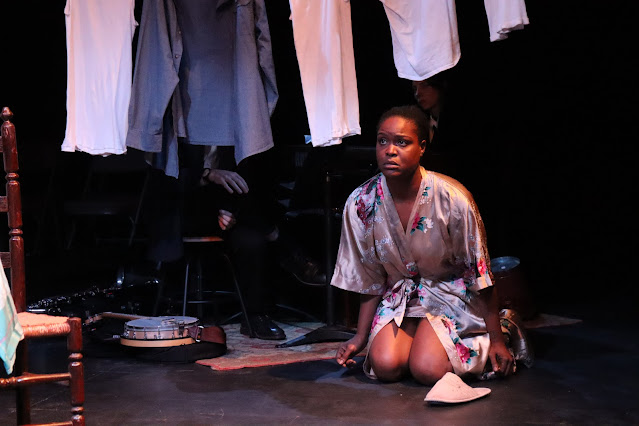
| Hailey McAfee. Photo by Ian McQueen |
If the question of *how* one defends the indefensible is repeated with nauseating regularity, the related questions of why, and perhaps most intriguingly, who, are less obvious. The Attic Collective’s and her Children (co-written by Rosie Glen-Lambert and Hailey McAfee) tackles these questions through a reimagining of Brecht’s Mother Courage and her Children (1939) in which the titular mother, Anna Fierling (McAfee), is now a spokesperson for the NRA defending the organization after a mass shooting. In shocking twists, we learn over the course of this one-woman show that Anna not only lost one son to gun suicide but also that her other son perpetrated the very shooting she has to defend (killing both his twin sister and himself in the process). Part of SoHo Playhouse’s 2026 International Fringe Encore series (January 3-March 26), and her Children is a powerful and ultimately deeply disturbing exploration of what might motivate the people who continually defend the so-called right to bear arms in the face of America’s gun violence epidemic.
 |
| Hailey McAfee. Photo by Ian McQueen |
Opening and closing with a haunting lullaby played by an unnamed violinist (Julia Hoffmann), the show is punctuated throughout by discordant violin noises that jolt Anna like stabs of conscience and serve to mark changes in the direction of her monologue. Appearing as a caricature of a right-wing type wearing a pale blue pantsuit and a delicate cross, carrying a Louis Vuitton tote, and sporting a bouncy bleached blonde blowout, Anna slowly reveals her personal connection to the gun violence she must explain away. While the play sets the scene as a press conference, a conceit it returns to towards the end when we find out that, disturbingly, the shooting Anna is defending was carried out by one of her own children, most of the show consists of an out-of-time, meandering monologue in which Anna explains how she came to work for the NRA as a single mom of three who defied the odds to finish college after becoming pregnant with twins. The question with which she continually grapples is whether or not she has been selfish in doing what she feels she had to do to support her children and keep her job.
 |
| Hailey McAfee. Photo by Ian McQueen |
McAfee’s portrayal of Anna’s complexity as a character is deeply compelling. At times, she is a sympathetic figure whose grit and resolve allow her to overcome the odds as a single mom to achieve a level of professional and personal success. But of course, this success is deeply problematic given her employer, even if Anna’s early point that there is no ethical employment under capitalism is a thought-provoking one, to say nothing of the familiar arguments marshalled in defense of that employer. Most poignant are the moments when we gain insight into Anna’s attitudes and actions towards her children, most especially her youngest child Sawyer and how she thinks she is protecting him by encouraging him to repress his homosexuality. Being bullied for his sexuality is what precipitates Sawyer’s death by gun suicide, using, of course, one of Anna’s own guns despite them being locked up.
 |
| Hailey McAfee. Photo by Ian McQueen |
As Anna’s personal connection to the gun violence that her own employer helps to perpetuate deepens, one would think she would have some kind of revelation about easy access to deadly firearms. After all, throughout the play, Anna is a type that we see constantly moving beyond the type. In the end, though, as her phone continues to ping with more and more notifications of other mass shootings, Anna prepares to carry on with her work, smiling almost maniacally and saying, “I’m sorry if you expected more from me.” It is a haunting and nihilistic conclusion that seems to enforce the gun lobby’s argument that, in fact, there is nothing that can be done to prevent America’s exceptional gun violence problem. If even someone so deeply impacted by it is not moved to change their position, how can we effect lasting systemic change?
-Stephanie Pietros


Comments
Post a Comment